
The children nobody counts

When a mother in the Philippines is detained, her children are not charged with anything and not recorded anywhere. This page sets out what is known about them, and what is not.
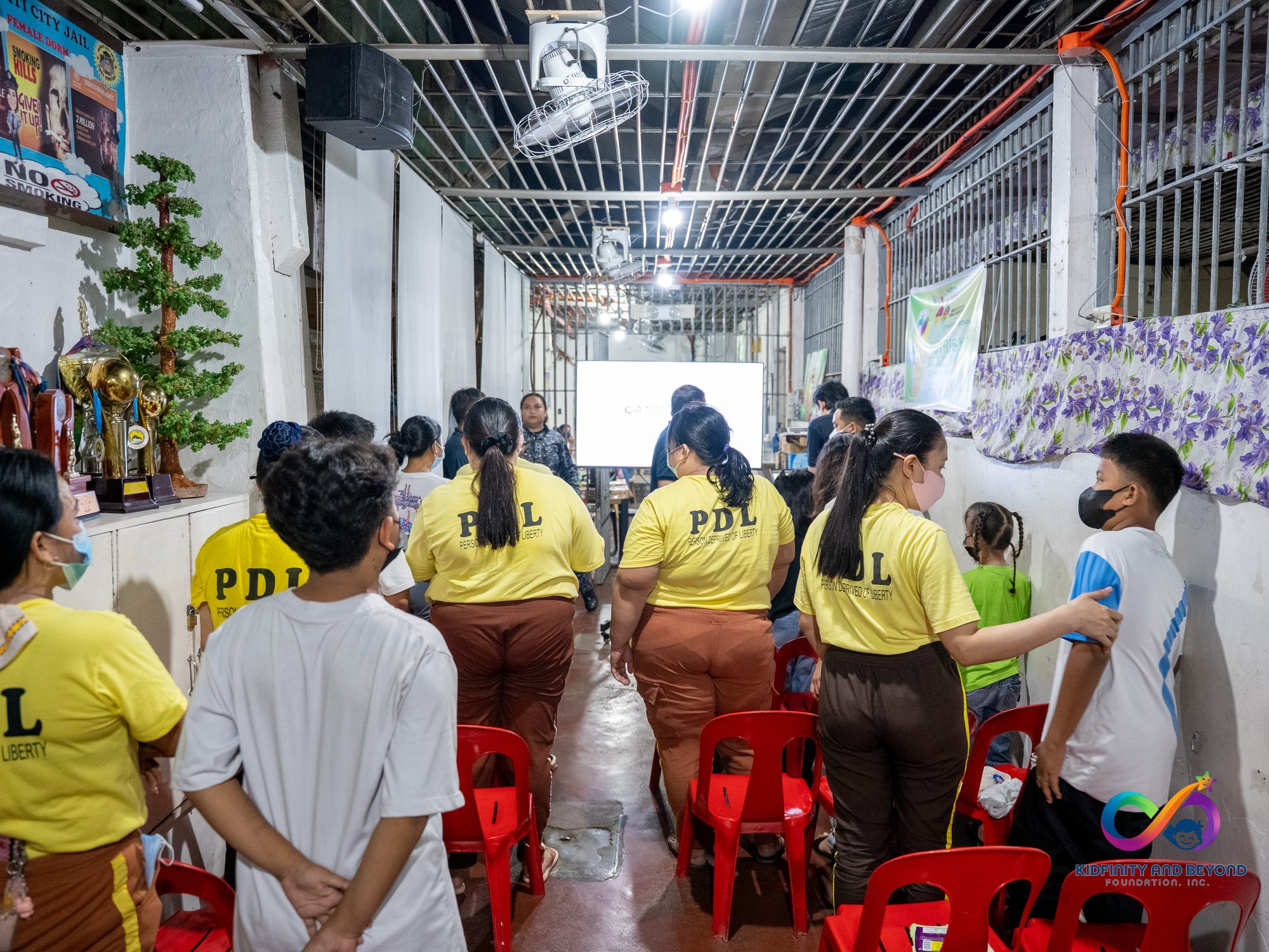
Mothers in yellow PDL shirts and their children stand among red plastic chairs in a long barred hallway, facing a screen.
Mothers and their children gather in the jail’s hallway for the orientation. Makati City Jail · 19 July 2026

The research is strong enough to act on, especially where school is concerned. It is not settled, and this page says where. Every figure is numbered to a source at the foot of the page.

The scale of detention

The Bureau of Jail Management and Penology runs 426 jails, which held about 113,500 people at the end of 2024.1 Their average congestion rate was 296% in May 2025. That is lower than in earlier years, and still nearly three times the number the buildings were built for.1 A Commission on Audit review found close to 70% of jails congested.2

Two features of the system matter more to children than the crowding does.

Most detention is provisional. About 70% of people held in Philippine jails have not finished trial.3 In law they are presumed innocent. Research on Metro Manila jails puts the average time in detention before a case is resolved at about 529 days.4 To a family, the difference between awaiting trial and serving a sentence is paperwork. The mother is gone either way, for longer than a school year and often for several.

Women’s jails are more crowded still. Women are a small share of those detained, so fewer and smaller facilities are built for them, and they fill past capacity sooner. Some female dormitories have recorded congestion rates in the hundreds of percent, and in the worst documented cases over a thousand.1 The share of women among Filipino detainees is above the global average,5 and most of the women held face drug-related charges.5

Why this is a children’s issue, not only a justice issue

The United Nations Rules for the Treatment of Women Prisoners, the Bangkok Rules, were adopted by the General Assembly in 2010. They say that when a court sentences, or decides pre-trial measures for, a pregnant woman or a child’s sole or primary caregiver, non-custodial measures should be preferred where possible and appropriate.6 The rules exist because detaining a mother imposes a cost on children who were never before the court. The Philippines has since issued its own guidelines for gender-responsive detention.7

Nobody knows how many children there are

No Philippine agency publishes a count of children with a parent in detention. When a person is booked into a jail, the number of children they leave behind is not recorded, acted on, or passed to any social service.

The Philippines is not alone in this. UNICEF has documented that the number of children affected by detention is unknown in many countries, because their records were never designed to capture it.8 Worldwide, the International Coalition for Children with Incarcerated Parents estimates that more than 22 million children have experienced a parent’s imprisonment.9 That figure is an estimate built from national studies, not a count.

The consequence is practical. When a mother is detained, nobody is told about her children. No case is opened, no school is informed, no benefit begins. Whether a child is reached at all depends on a relative knowing where to ask, or an organization being in the right jail on the right day. That is the gap the Foundation was set up to fill.

What the research finds, and where it is uncertain

The most recent review focused on school is by Taggart and McAloon, published in Psychiatry, Psychology and Law in December 2025. It brought together 16 studies with 301,220 participants, and found a parent’s incarceration associated with lower school readiness, weaker reading and arithmetic, lower grades in high school, and a lower chance of finishing high school and college.10

A 2025 meta-analysis by Liu and colleagues in Trauma, Violence, & Abuse looked at whole families: 53 studies and 101,417 people in eight countries. A family member’s incarceration was associated with more psychiatric symptoms, most strongly substance misuse and behavioral problems. The authors call for support aimed at the whole household rather than one person in it.11

ReviewEvidenceWhat it found
Taggart and McAloon (2025)16 studies
301,220 participants
Lower school readiness, literacy, numeracy and grades; less likely to finish high school and college
Liu and others (2025)53 studies
101,417 people, 8 countries
More psychiatric symptoms across affected families, strongest for substance misuse and behavioral problems
Murray, Farrington and Sekol (2012)40 studies
44,699 children
Antisocial behavior stayed higher; the links with school and mental health weakened once earlier disadvantage was taken into account

The newer research points the same way, particularly on school. Three cautions shape how the Foundation uses it.

An association is not proof of cause. Many families were already facing poverty and instability before an arrest. The earlier Murray review found that once those conditions were taken into account, the link with school performance was no longer statistically significant.12 The larger, more recent body of studies points more consistently to harm, but most of it is observational, so how much of the damage the incarceration itself causes remains open.

Almost none of the research is Filipino. The studies come mostly from the United States, Europe and Australia. We found no comparable research from the Philippines, where pretrial detention is longer, jails are more crowded and the safety net is thinner. The effects here may well be larger. They have not been measured.

Mothers are barely studied. A 2025 scoping review found only three studies anywhere that compared the imprisonment of mothers and fathers within the same population, and their results conflict.13

Why we publish the uncertainty

A program built on an overstated claim breaks when the claim is checked, and the families we serve are not helped by being described as damaged. The evidence is strong enough to act on, especially on school, without pretending it is settled.

The part that is well supported: money, care and school

The evidence is most consistent, and most within a foundation’s reach, on money. Detaining a mother removes at once a household’s income, its childcare, and the adult who handled its paperwork: enrollment, documents, fares, uniforms, permission slips. The person who takes over is usually a relative already living close to the edge.

In the Philippines, the cost of school sits right in the path of that shock. Nearly 11 million Filipino children and young adults are out of school, and about 53% of out-of-school children and youth come from households in the poorest 30% by income.14,15 Families give money among their reasons for a child not attending,14 and it is the reason most open to help. No one can change a family’s history, but someone can pay for a bag, a set of books and a fare.

School is also where the second well-documented harm appears: stigma. Studies keep finding children working hard to keep a parent’s detention secret, and being bullied when it becomes known.16 Teachers say they lack the knowledge to support these children, and some expect less of them because of what they know about the parent.16,17 A child trying not to be noticed does not ask for help, and a teacher who expects less does not offer it.

What the Foundation does about it

If the lasting harms are lost income, weaker care, long separations and stigma, rather than something wrong with the child, then help should go at those. That is why the Foundation runs four programs rather than one.

The cost of school

The KIDS Program puts a school bag, grade-appropriate supplies and educational assistance in the child’s hands at the point the household would otherwise go without. This is the part of the work with the clearest link to the evidence.

Distress and weaker care

The Foundation’s work with children includes psychosocial care, life skills and support for confidence, through KIDS and through YAKAP, which is named for care, nurture and hope.

The mother’s return

SINULID ng Pag-asa works with mothers on livelihood, upskilling and preparation for release, with up to a year of support after she comes home. A mother who leaves detention with a skill and a plan changes her children’s prospects.

The length of the separation

With seven in ten detainees awaiting trial and cases taking well over a year,3,4 moving a mother’s case is one of the most direct ways to shorten a child’s separation. LAYA gives mothers legal assistance, in line with the Bangkok Rules’ preference for non-custodial measures for sole caregivers.6

How the Foundation checks its own work

The research cannot tell us whether our own programs work, so we keep our own record. For every scholar and every grading period, the Foundation records the grades submitted, the reviewer’s decision and the assistance released. That record is how the Foundation judges its work, including when scholars fall behind.

The four programs

Sources

  1. Bureau of Jail Management and Penology congestion figures, reported by Manila Bulletin, “BJMP congestion rate down in 2024” (26 January 2025) and subsequent 2025 reporting.
    https://mb.com.ph/2025/1/26/bjmp-congestion-rate-down-in-2024
  2. Commission on Audit report on jail congestion, as reported by the Philippine Daily Inquirer.
    https://newsinfo.inquirer.net/2153860/fwd-coa-on-bjmp-report-on-jail-congestion
  3. United Nations News, “Philippines: Humane approach to incarceration relieves chronic prison overcrowding” (July 2024).
    https://news.un.org/en/story/2024/07/1152051
  4. Research on prolonged pretrial detention and bail in the Philippine criminal justice system.
    https://www.presocbb.org/post/prolonged-pretrial-detention-and-bail-in-the-philippine-criminal-justice-system
  5. Rappler, “What you should know about women prisoners in the Philippines.”
    https://www.rappler.com/newsbreak/iq/things-to-know-women-prisoners-philippines/
  6. United Nations Rules for the Treatment of Women Prisoners and Non-custodial Measures for Women Offenders (the Bangkok Rules), General Assembly resolution 65/229, 21 December 2010.
    https://www.unodc.org/documents/justice-and-prison-reform/Bangkok_Rules_ENG_22032015.pdf
  7. Philippine Commission on Women, Joint Memorandum Circular 2025-04: Guidelines on Gender-Responsive Detention Facilities and Services.
    https://pcw.gov.ph/jmc-2025-04-guidelines-on-gender-responsive-detention-facilities-and-services/
  8. UNICEF, “Estimating the number of children deprived of liberty in the administration of justice,” which documents the absence of administrative data on children affected by detention.
    https://data.unicef.org/resources/children-in-detention-report/
  9. International Coalition for Children with Incarcerated Parents (INCCIP), global estimate of children who have experienced a parent’s imprisonment.
    https://www.penalreform.org/issues/children/what-were-doing/children-incarcerated-parents/
  10. Taggart, N., & McAloon, J. (2025). The association between parental incarceration and children’s educational outcomes: A systematic review. Psychiatry, Psychology and Law. Published online 16 December 2025.
    https://doi.org/10.1080/13218719.2025.2578536
  11. Liu, H., Li, C. J., Wong, E. L., Peng, Z., Wang, A., Chan, S. K. Y., & Hou, W. K. (2025). Family incarceration and mental health among 101,417 affected families: A systematic review and multilevel meta-analysis. Trauma, Violence, & Abuse.
    https://doi.org/10.1177/15248380241306353
  12. Murray, J., Farrington, D. P., & Sekol, I. (2012). Children’s antisocial behavior, mental health, drug use, and educational performance after parental incarceration: A systematic review and meta-analysis. Psychological Bulletin, 138(2), 175–210.
    https://pmc.ncbi.nlm.nih.gov/articles/PMC3283435/
  13. Scoping review of the impact of maternal versus paternal imprisonment on children’s health (2025), which identified only three studies making a direct within-population comparison.
    https://pmc.ncbi.nlm.nih.gov/articles/PMC12306776/
  14. Philippine Statistics Authority census and survey data on out-of-school children and youth, as reported in 2024.
    https://www.philstar.com/headlines/2024/05/15/2355189/nearly-11-million-children-youth-not-school
  15. Philippine Institute for Development Studies, analysis of out-of-school youth and household income.
    https://pids.gov.ph/details/out-of-school-youth-in-ph-now-number-3-8m
  16. Qualitative research on the school lives of children with an imprisoned parent, International Journal of Educational Development.
    https://www.sciencedirect.com/science/article/abs/pii/S0738059317305886
  17. Turney, K., “Understanding the Needs of Children with Incarcerated Parents,” American Educator (Summer 2019).
    https://www.aft.org/ae/summer2019/turney

Links to other websites are given so that every figure can be checked. The Foundation is not responsible for their content, and a link does not mean the Foundation endorses an organization’s wider positions.